
The problem is major, and the problem affects hundreds of millions of people. Ignoring it must have a sound reason. Ignoring it must in some way be more important than addressing it, notes Aakar Patel.

'Two consecutive quarters of negative growth are the technical definition of an economic recession, and for the first time in this generation's memory, we may be staring at one,' observes Aakar Patel.

India's growth, he said, remains resilient with low inflation, fiscal prudence and low current account deficit, talking about robust structural reform measures.
RBI said aggregate demand during the year so far suggests that the shock to consumption is severe, and it will take quite some time to mend and regain the pre-COVID-19 momentum.

The benefit coming in from the Rs 1.45 lakh crore tax giveaways will also help companies to cut prices by up to 5 per cent to boost consumer demand, which has been sagging and is one of the prime reasons for the deepening slowdown.
'The large scale and widespread shrinking of the labour force in November, the peaking of unemployment in October and the fall in lead indicators in October and November point towards a worsening of the slowdown of the Indian economy in the third quarter of 2019-20,' says Mahesh Vyas.

Retail investors may safely invest in shorter-duration funds, suggests Sanjay Kumar Singh.
'Our government has created 10 million jobs when the Indian unemployment rate is at a 45-year high.'

IThe fiscal deficit target for 2020-2021 was originally set at 3.5 per cent of GDP. But the government's revenues have collapsed and its expenditure burden will only increase over the Budget estimates.' With the government having already planned for an additional borrowing of over Rs 4 trillion, the fiscal deficit for the current year would be much higher than the Budget estimate, notes A K Bhattacharya.

The sentiment in the real estate industry turned optimistic during October-December 2020 and the outlook for the next six months is positive on the back of revival in demand for both residential and office properties, according to a survey by Knight Frank India-FICCI-Naredco. The 27th edition of 'Real Estate Sentiment Index Q4 2020 survey' of developers, banks, financial institutions and private equity players operating in the sector was released on Monday in a video-conference. As per the report, the 'Current Sentiments Score', for the first time in 2020, entered the optimistic zone at 54 points in Q4 (October-December) 2020, a significant jump of 14 points over the previous quarter.

'The term 'pro-growth' must be qualified somewhat because, while a rising tide will lift all boats, it will not necessarily do so equally.'

'If global growth continues to be sluggish, India instead could potentially take a bigger piece of a shrinking pie,' says Prachi Mishra, managing director, Global Macro Research, and India chief economist, Goldman Sachs.

Goldman Sachs report said, "India has a fifth of the world's population, but only a 30th of its energy".

The pandemic has led to the International Finance Corporation massively ramping up its impact investment in the country - its largest client nation globally - at $1.7 billion as of June, a 51 per cent rise over the past 12 months, the largest developmental lender into third world private sector said on Tuesday. This is nearly half of its investment in the whole of South Asia since the pandemic, which touched $3.8 billion as of June 2021, it said. "Our total commitment to India, which is our largest client country globally, at the end of June stood at $1.7 billion representing an increase of over 51 per cent from last year," IFC vice-president for Asia and the Pacific region Alfonso Garcia Mora said in a statement.

There's no place like home, but even for the affluent buying one in India is difficult. On top of that, the coronavirus pandemic-now in its eighteenth month-has made life uncertain. A hopeful thing is buying a house looks alluring as loan interest rates fall below 7 per cent, their multi-decadal lows. The slow decline in GDP growth after demonetisation, followed by the economic shock caused by Covid-19 waves, has hurt us unevenly.

'The situation is quite terrifying as you have no job creation and there will be loss of jobs.'

Axis Bank was the top gainer in the Sensex pack, surging around 7 per cent, followed by Ultratech Cement, L&T, ICICI Bank, SBI, M&M and Bajaj Finance. On the other hand, Nestle India, Sun Pharma, Bharti Airtel and HUL ended in the red.
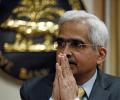
Uncertainty is emerging as the only certainty, said RBI Governor Shaktikanta Das as he emphasised on continued policy support at the December MPC meet during which members expressed concerns over spread of the Omicron variant of coronavirus, as per the minutes of the rate-setting panel released on Wednesday. After three days of deliberations, the six members of the Monetary Policy Committee (MPC) on December 8 unanimously voted for status quo on policy rates for the ninth consecutive time. At the meeting, the RBI Governor said risks stalking the global economy have amplified with rapid spread of the virus mutations, including the Omicron variant, leading to countries scrambling for restrictions.

Top losers in the Sensex pack included ICICI Bank, Tata Steel, Vedanta, HDFC IndusInd Bank, Tata Motors, RIL and ONGC -- falling up to 4.45 per cent.

'Good investment opportunities should not be missed.'

The RBI on Wednesday provided more time to exporters to collect payment of goods and software sold to overseas buyers and repatriate that to India, as the central bank announced more measures to deal with the economic fallout of the Covid-19 pandemic. The central bank has also decided to increase the limit of advances it gives to states and UTs by 30 per cent under the Ways and Means (WMA).

It had upped India's rating to Baa2 from Baa3 and changed its rating outlook to 'stable' from 'positive', saying the reforms would help stabilise rising levels of debt.

While asserting that the growth of coronavirus cases in the country has been more or less linear and not exponential, it also said testing has been ramped up consistently.

The pre-Budget Survey said for wealth to be distributed, it first has to be created and called for looking at wealth creators with respect. The Survey said government interventions seem to be ineffective in stabilising prices of commodities such as onions.

'There is a vision in the Budget, and the vision is to take India from a largely agrarian, rural economy into a fast-track digitalised economy.'

'We are looking at the Budget with the hope that it will address all issues even at the cost of exceeding the fiscal deficit target.'

India's economy, estimated to contract by 6.9 per cent in 2020 due to the coronavirus pandemic, is forecast to record a "stronger recovery" in 2021 and grow by 5 per cent, according to a UN report which said the country's current fiscal year budget points to a shift towards demand-side stimulus, with an uptick in public investment. The report, 'Out of the frying pan ...Into the fire?' published Thursday as an update to the Trade and Development Report 2020 by UN Conference on Trade and Development (UNCTAD) said the global economy is set to grow by 4.7 per cent this year, faster than the 4.3 per cent predicted in September 2020, thanks in part to a stronger recovery in the US, where progress in distributing vaccines and a fresh fiscal stimulus of $1.9 trillion are expected to boost consumer spending.

India lags behind 132 countries in per capita income.
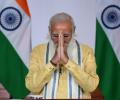
A report by the Azim Premji University showed that during the pandemic 270 million Indians were pushed into poverty. Meaning that they were not poor according to the government poverty line before, but have become now. Aakar Patel mulls on the state of the nation as the Modi government enters its eighth year.

Economists have said if a stimulus is needed it should be different from what was provided in 2008-09, when the economy faced the ripple effects of a global meltdown following the Lehman Brothers collapse.

It doesn't make sense to view the womb through the prism of religion, community and tradition, warns Shyam G Menon.

Indian economy is expected to expand at 8.5-9 per cent over 10-15 year time frame once the structural issues hampering growth are addressed by the government.

The revenue collection in the same month a year ago stood at Rs 94,442 crore.

The global ratings agency, however, cautioned that high debt burden remains a constraint on the country's credit profile.

Companies in China, South Korea and Indonesia pay 25 per cent tax, while those in Malaysia pay 24 per cent. Only Japan has a higher tax than India at 30.6 per cent. Hong Kong has the lowest corporate tax rate of 16.5 per cent while Singapore has 17 per cent rate and Thailand and Vietnam levy 20 per cent tax on companies.
He exuded confidence that the Indian economy will grow at 5.3 per cent in 2013-14.

There is no direct impact of the Russia-Ukraine crisis on India in terms of bilateral trade but a surge in oil prices poses considerable risk to the economy, an analyst report said on Friday. International oil prices which have surged past $100 per barrel "pose risks to external stability and currency movement," a Bank of Baroda Economics Research report said. Russia has launched military operations against Ukraine, stoking fears of significant disruption in the region, including loss of life. The West is ramping up financial sanctions against Russia and support for Ukraine.
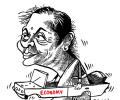
While the situation Sitharaman finds herself in may not be that good, how does it stack up against her three immediate predecessors Pranab Mukherjee, P Chidambaram and the late Arun Jaitley?

Growth forecast has been lowered owing to tepid growth in the first half of 2017-18, the lingering effects of demonetisation, transitory challenges of GST, and some risks to agriculture stemming from a spotty monsoon.

But the measures, particularly in agriculture, may not be enough to revive the sector and double the farm income, says S Mahendra Dev.
 © 2026 Rediff.com - Advertise with us - Disclaimer - Privacy Policy - Sitemap - Feedback - About us - Terms of use - Grievances